Why waste heat?
Use the energy twice.
Nice.

How it works
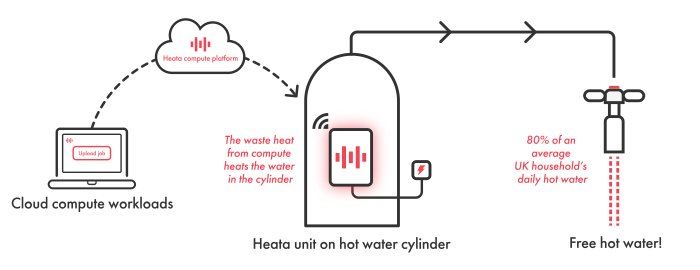
The heata unit is attached to domestic hot water cylinders and the heat generated by the data processing is transferred through the cylinder wall into the water in the cylinder.
Think of it like a steady trickle throughout the day, rather than a burst of intense heat like a kettle. As a result the household's primary heating system comes on less often, saving them money.
Benefits for households and landlords
- Uses energy twice, for compute and hot water.
- We pay for the electricity we use, saving households:
- Up to £150 / year (offsetting gas).2
- Up to £350 / year (offsetting electricity).2 - Each unit saves up to 750kg of CO2e / year.3
- Easy to install and update, no plumbing required.
- Fits vented hot water cylinders, a version for unvented cylinders is in development.

Meet Ian, one of our hosts

Working in IT I know how much heat servers give off.
Re-using it to offset hot water heating makes so much sense.
Ian, Bordon, UK

Installation overview
Our patented thermal bridge is fitted to vented domestic hot water cylinders and provides the attachment point for our powerful server.
We've tested the installation process with British Gas engineers and checked that it doesn't invalidate cylinder warrantees with one of the UK's largest cylinder manufacturers.
.webp%3F2026-09-10T16%253A03%253A04.828Z&w=3840&q=100)
INSTALLATION TESTED BY BRITISH GAS

- [UPDATE] A 10MW data centre consumes ~88GWh of power per year. At a Power Usage Effectiveness of 1.6, this equates to ~54,750MWh/year. Average daily UK domestic hot water energy use is 4.65kWh/day, or 1.697MWh/year [4].
- Yearly cost saving is based on hot water heated with electricity at 22p/kWh, or heated with gas at 7.8p/kWh (takes into account a boiler efficiency of 70%[5]), with the heata unit supplying 4.25kWh of hot water per day. A billing accredited submeter is installed along with the heata unit and the household is credited for the amount of energy that the heata unit uses.
- CO₂e saving is based on: Typical Data Centre + domestic hot water: 750W/hour (330W compute + 200W cooling[6] + 220W hot water) vs heata: 330W/hour (330W compute, including 220W harnessed from waste heat), at 80% utilisation across the year. Carbon intensity is 0.274kg CO₂e/kWh, this is derived from the blend of heating sources in the homes in the heata network. Base carbon intensity is 0.236 CO₂e/kWh for Electricity and 0.290 CO₂e/kWh for Gas, taking into account an assumed boiler efficiency of 70%[5].
- Measurements of Domestic Hot Water Consumption in Dwellings.
- Greenhouse Gas Reporting Conversion Factors 2023.
- Ni, Jiacheng & Bai, Xuelian. (2017). A review of air conditioning energy performance in data centers. Renewable and Sustainable Energy Reviews. 67. 10.1016/j.rser.2016.09.050.